
Subterranean Termite Inspection & Treatment in Scottsdale, AZ
- Pest Control Service in Scottsdale
- Bark Scorpion Control
- Scorpion Exclusion & Weep-Hole Sealing
- Roof Rat & Pack Rat Control
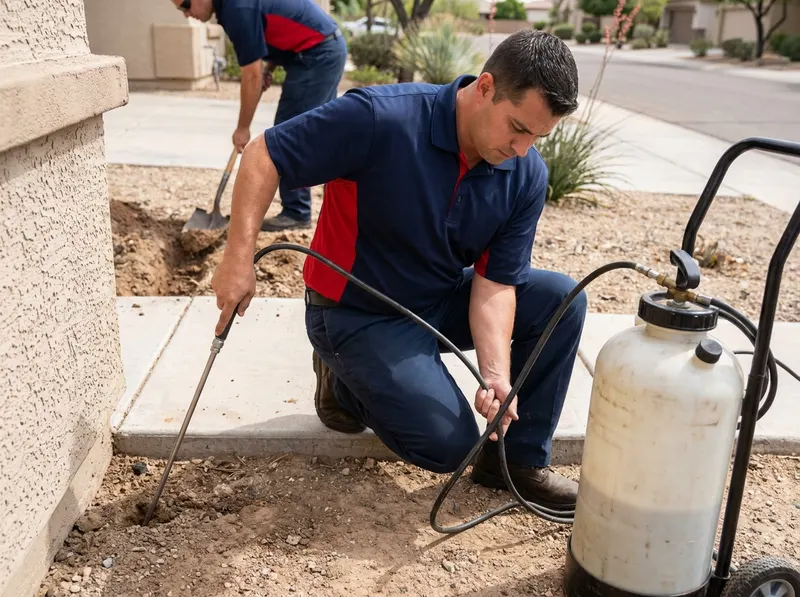
- Included: full interior and exterior inspection (garage, baseboards, patio slabs, block wall stems, attic access where reachable), written findings with the activity locations noted, then trench-and-treat or drill-and-treat of the affected soil with a labeled liquid termiticide.
- Timing: inspections are typically scheduled within a few business days, and most single-family termite treatments in Scottsdale are completed in one visit of two to five hours depending on perimeter length and how much slab drilling is needed.
- Cost: termite work in Scottsdale starts at a $250 minimum and commonly falls between $250 for a localized spot treatment and roughly $2,200 for a full perimeter on a typical slab home — a ballpark, with the exact figure confirmed after the free on-site inspection.
- What we handle: active mud tubes on interior and garage walls, swarmers after monsoon storms, activity along patio and expansion joints, wood-to-soil contact at door thresholds, and soil treatment around slab and block-wall footings.
- Booking: call or text (520) 677-2776 with the address and where you found the tubes or wings — send a photo if you have one, and we will tell you before we arrive whether it reads as termite activity or something else.
The decision most Scottsdale homeowners face is spot treatment versus full perimeter, and the honest split is about how the termites are getting in. A single mud tube on one garage baseboard, on a home with no prior history, is often a localized problem — one trench along that elevation, or a few drilled holes through the garage slab at the expansion joint, addresses the route being used. A <strong>full perimeter trench-and-treat</strong> makes sense when there is activity on two or more elevations, when swarmers have appeared indoors, when the home has never been treated, or when the footprint includes patio slabs, an enclosed Arizona room or an addition poured against the original slab. The trade-off is straightforward: spot treatment costs less and solves what is in front of you, while a perimeter treatment covers the soil the colony forages through and is the more durable choice on a home showing activity in multiple places.
Scottsdale's landscaping drives a lot of this. In <strong>McCormick Ranch, Gainey Ranch and Scottsdale Ranch</strong>, decades-old drip and turf irrigation keeps soil against the stem wall damp year-round, which is exactly the moisture condition desert subterranean termites need to forage close to the house. Lots backing the Indian Bend Wash Greenbelt sit next to irrigated turf and mature trees, and buried construction scrap — form boards, stakes, old root balls — is a common food source we look for near the foundation. On the north side, in <strong>Troon North, Desert Highlands and McDowell Mountain Ranch</strong>, homes built against granite outcrops and natural desert wash channels get activity along the wash-facing elevation, where runoff after McDowell Sonoran Preserve storms concentrates moisture. In <strong>DC Ranch and Grayhawk</strong>, stucco that has been buried by later landscaping rock covers the weep screed and gives termites a hidden path behind the finish. Older <strong>Old Town Scottsdale</strong> and Village Grove homes bring a different pattern: multiple additions, patio enclosures and cold joints between slab pours, each one a seam we probe specifically.
What we tell you before anything is applied: the product name, where it goes, and how long until kids and pets should stay off treated areas. Liquid termiticide for subterranean work goes into <strong>soil</strong> — trenched along the foundation, rodded, or injected through small drilled holes that get patched — not misted around your living space, which is a difference worth understanding when you have a toddler and a dog. We also flag the non-chemical corrections that matter, because chemistry alone does not fix a planter box holding wet soil against stucco or a door threshold sitting in grade. <strong>Sealed out, not just sprayed down</strong> applies here as much as it does to scorpions.
This is defined project work, not a subscription. Termite treatment in Maricopa County is quoted as a job with a scope and a price, and we will put in writing what the treatment covers and what any manufacturer or service period on the applied product includes — no 12-month contract required to get the inspection done. If a lender, escrow or HOA requires the state's wood-destroying insect report form, say so when you call so we confirm the correct scope before scheduling.
Call (520) 677-2776Subterranean Termite Inspection & Treatment pricing in Scottsdale
| Termite inspection with written findings (standalone, no treatment) | $250 |
| Localized spot treatment — one wall run, garage baseboard or single tube location | $250 – $600 |
| Partial perimeter trench-and-treat — one or two elevations, or patio side only | $500 – $1,200 |
| Full perimeter trench, rod and treat — typical Scottsdale slab home | $900 – $2,200 |
| Slab drilling through garage floor, patio or expansion joints (added to treatment) | $350 – $900 |
| Large-footprint or custom home — long block-wall perimeter, multiple additions | $1,800 – $3,500+ |
Exact price confirmed free on-site before any work.
Subterranean Termite Inspection & Treatment — questions, answered
How do I know the mud tubes on my Scottsdale garage wall are subterranean termites?
Desert subterranean termites in Scottsdale build thin, ropey mud tubes that run vertically up block walls, stem walls and garage baseboards, and the tube is hollow with live insects inside if the activity is current. Break a small section open — if it is repaired within a week, the colony is actively foraging there. Ants leave dirt piles but not enclos