
Pigeon & Bird Exclusion on Tile Roofs in Scottsdale, AZ
- Pest Control Service in Scottsdale
- Bark Scorpion Control
- Scorpion Exclusion & Weep-Hole Sealing
- Subterranean Termite Inspection & Treatment
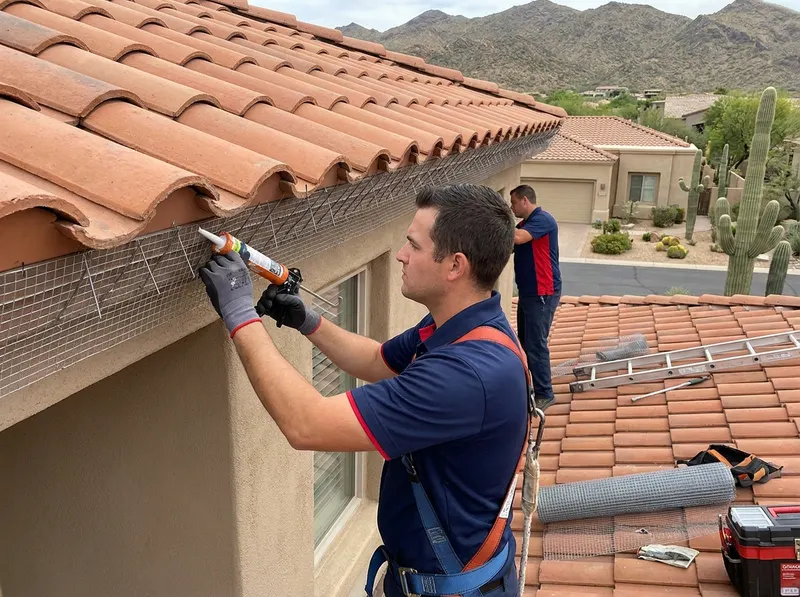
- What's included: roof-level inspection of the eave course, hips, ridges, valleys and solar array; removal of nesting material and droppings from the affected sections; installation of galvanized or powder-coated mesh, bird stops or eave closures at every open tile end; a written note of what was sealed and what was left open and why.
- How fast: most single-family tile roofs in Scottsdale are inspected and quoted in one visit, with the exclusion install completed in one to two working days depending on roof size, pitch and whether solar panels have to be worked around.
- What it costs: pigeon and bird exclusion work starts at a $250 minimum for a small single-section job; a full eave-line closure on a typical Scottsdale tile roof commonly lands in the low four figures. Ranges below are ballparks, and the exact figure is confirmed on a free on-site visit.
- What we handle: pigeons (rock doves), house sparrows and European starlings — non-native species with no federal nesting protection — plus the nesting debris, feathers and droppings left behind under the tile.
- How to book: call or text (520) 677-2776 with your neighborhood and what you're seeing (birds landing at the eave, cooing above a bedroom ceiling, droppings down a stucco wall) and we'll schedule the roof inspection.
The reason pigeons keep coming back to a Scottsdale tile roof is architectural, not behavioral. Barrel and S-tile leave a curved void at the bottom course of every run, and on many homes built through the 1970s and 80s in <strong>McCormick Ranch, Scottsdale Ranch and Gainey Ranch</strong> that eave course was never fitted with bird stops. A pigeon walks in about eight inches, finds shade, and has a nest site that stays usable through a 112-degree July. Newer concrete S-tile in DC Ranch, Grayhawk, McDowell Mountain Ranch and Troon North usually has closures at the eave, but rooftop solar changed the math — the four-to-six-inch gap between panel glass and tile is now the most common nesting cavity we're called about, and the birds enter from the side, not the front. In Old Town Scottsdale and Village Grove, the pattern shifts again toward parapet ledges and flat-roof mechanical curbs, with birds commuting from the water at the Indian Bend Wash Greenbelt and the golf-course lakes.
Decide between exclusion and deterrents by asking where the birds actually are. Spikes, gel and sound devices address birds <em>standing</em> on a surface; they do nothing about birds <strong>living inside the tile cavity</strong>, which is the Scottsdale norm. Trapping or hazing gives a quiet week or two and then the flock cycles back, because the vacancy is still there. Exclusion is the durable answer and the trade-off is honest: it costs more up front, it requires walking a tile roof (some steep hillside roofs in Desert Highlands and Troon North need extra staging), and in HOA neighborhoods the mesh color usually has to match trim or fascia to pass architectural review — we'll spec dark bronze or black and give you something to submit. Deterrent-only work makes sense in one situation: a single ledge or parapet with no cavity behind it.
Timing matters in Maricopa County. Pigeons nest year-round here, so there is no closed season on that work, but native species are different — an active dove or finch nest with eggs is federally protected, and we will time around it rather than disturb it. We also try to get eave and valley work done before monsoon season, because packed nesting debris dams a tile valley and pushes water sideways under the tile during a heavy August storm. Late fall through spring is the easiest install window, and it lines up with the season when homeowners near the McDowell Sonoran Preserve and Pinnacle Peak Park are already on the roof for other maintenance.
Cleanup is part of the job, not an add-on afterthought. Accumulated droppings and nesting material can carry mites and airborne spores, so removal is done in protective gear, bagged, and hauled off — and we tell you plainly if we find follow-on issues under the tile, like a torn underl
Call (520) 677-2776